

Rough Notes: Puzzling Through The Valkyries Media Day
Three big takeaways + behind-the-scenes for the lucky ones.

This is a Rough Notes Deep Dive: writings on current cultural + political moments in the WNBA & women’s basketball history. They are mostly free, with more candid behind-the-scenes just for for paying subscribers; upgrade your subscription to dive the deepest every time.
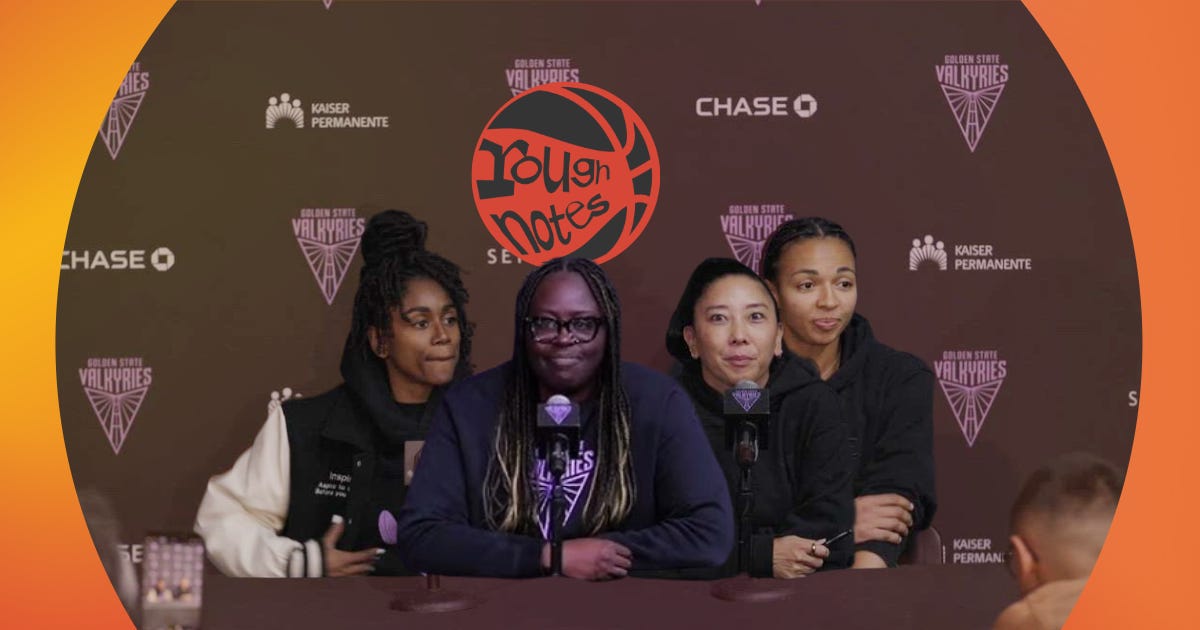
Yesterday, I spent the afternoon in a corner of the Sephora Performance Center (aka the Valks’ practice facility) with enough journalists to fill a small wedding reception. The afternoon started with a bang: a much-anticipated appearance by General Manager Ohemaa Nyanin, during which I thought to myself: “okay, let everyone else write about this, there will be so much more to come.” But truthfully, it was that first interview that stuck with me — and for the rest of the day, I mulled through it like a puzzle, including for an hour over coffee with one of my absolute favorite journalists, Eric Apricot (his work is an essential read for all Valkyries fans, for real.) All of this is to say, here are three major interpretations from the day that I settled on, and wanted to share with you:
#1: The Golden State Valkyries roster was nearly impossible to make this year…
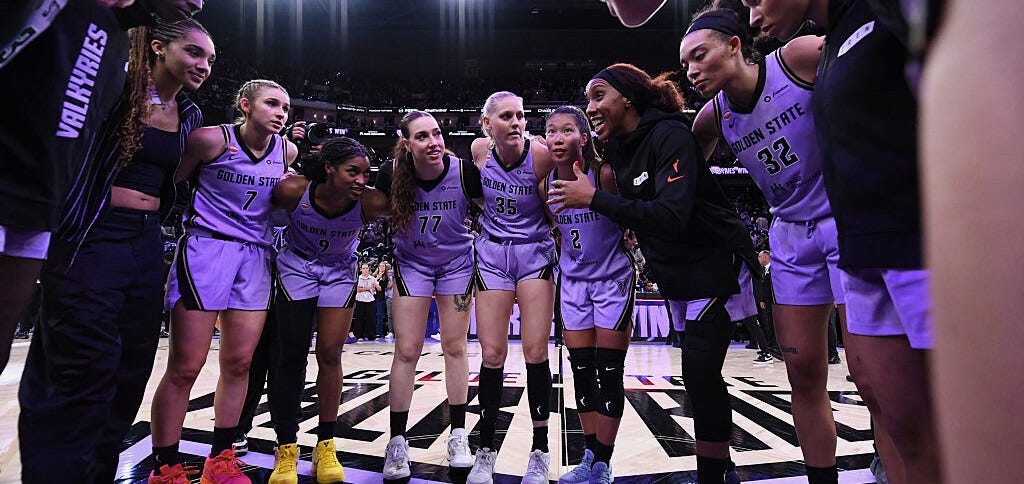
… if you hadn’t already spent time playing with the team last year, or you aren’t Gabby Williams/Kiah Stokes, the two non-Valks players signed during free agency. But in terms of earning a spot on the roster through training camp, including for any newly drafted (or traded-for) rookies, that seems to have been something of a mirage. I think the writing has been on the wall for a while, especially since - as Ohemaa Nyanin just told press again at media day - Golden State made “sure to sign as many returners as possible.”
The identity of the Valkyries in year two is clear: it’s all about deepening pre-existing relationships born from year one, which on the flip side also kinda means: “no new friends” (or maybe: “just two new friends.”) During this era of the WNBA, when preseason is heightened by media coverage, rookies carry a higher profile, and more money is at stake than ever before, that strategy can have a particular stinging effect, especially when the Valkyries chopped 6 players at once last Saturday, including top 2026 draft pick Marta Suárez. But in many ways, that just reflects their blueprint already in place.
#2: Which can help explain *some* of the confusion lingering from draft night:
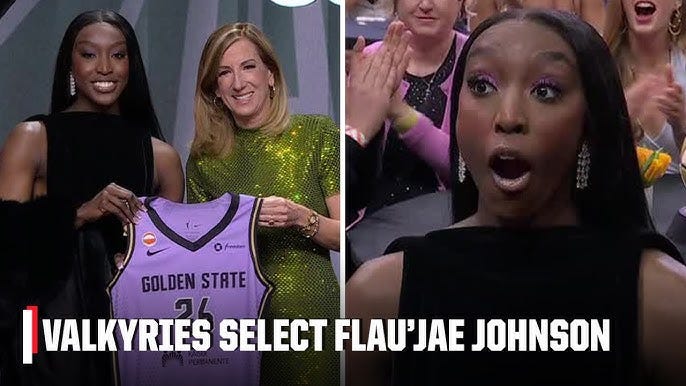
There’s been a ton of chat across WNBA social media trying to make sense of General Manager Ohemaa Nyanin’s decision on draft night to give up Flau’jae Johnson (Golden State’s #8 overall pick) in exchange for Marta Suarez (Seattle’s #16 pick) - especially after Ohemaa’s non-answers to the press afterwards exacerbated confusion and critique.
Media day was the first time the press once again addressed the Valks’ General Manager about her draft night strategy — though, not the first time the press could have asked a follow-up question because, as Ohemaa pointed out, she was present at Gabby Williams’ introductory presser on April 25 — but would she really have given an answer to someone interrupting that all-time celebratory flow? (C’mon now.)
This time around, Ohemaa offered a bit more explanation, which I didn’t find completely not-entirely a little bit and not exactly confusing (you know what I mean?) But after dissecting it all, here’s what I think happened: First, the Valkyries were interested in a potential trade before draft night began, but the trade was not yet finalized when the selections began. (This comes from: “It wasn’t decided before, but there was the option to execute the trade should both teams have wanted to execute the trade at the time.”)
Which means by the #8 pick, the Valks were not interested in selecting any of the remaining athletes, due in part to the guaranteed salary that comes with being a first round draft pick (thank you, Eric, for pointing this out!) as well as the presence of another mystery athlete the Valks were interested in signing, though it never panned out (This comes from: “The decision-making around the draft had a lot to do with cap flexibility… We had the opportunity, or we thought we had the opportunity, to potentially sign another athlete.”)
Which implies that, upon evaluating whether to bring Flau’jae Johnson to training camp as the #8 pick on the night of the draft, the Valkyries indeed decided they weren’t interested (This comes from: “No athlete was considered at that moment in terms of us trading an athlete, at number 8, and then… does that make sense?”)
Which, finally, resulted in Golden State’s decision to follow through with the potential trade on the table — taking Flau’jae at #8, as instructed by Seattle, in return for Seattle drafting Marta at #16, as instructed by Golden State.
What’s kind of getting muddled up here is that while yes, the Valkyries were simply executing Seattle’s selection of Flau’jae according to their trade agreement, they weren’t doing so blindly. They had just decided, in that moment before Flau’jae stood proudly wearing Valkyries violet, that she was not a fit for Golden State. And they had likely also determined that trading out of the first round would give them more of a leeway to eventually cut the second round draft pick during a training camp that was impossible to survive in the first place (see takeaway #1!) But that’s not something I think we’ll ever hear anyone in the front office say out loud.
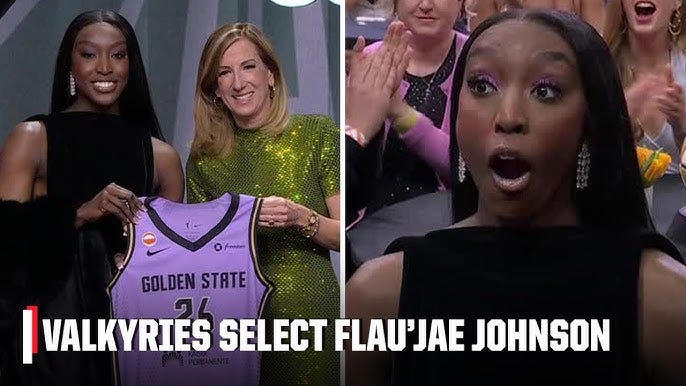
final flau’jae-almost-a-valkyrie haunting: remember how her eyeshadow matched? #3: Most importantly: Strategy is one thing, but communication is another.
Whatever Golden State’s strategy may be, there was this felt tension between Ohemaa Nyanin and the press today when it came to understanding those decisions. Maybe tension isn’t the right word, perhaps it’s strain - for journalists, to get answers to burning questions the public will want to ask (as in, basically, “did you trade the #8 pick knowing it was Flau’jae?”) and for the Valkyries, to protect their strategic process and most especially, their image. As Eric pointed out, if Ohemaa had just come out and said, “We really didn’t want Flau’jae,” there would have been hell to pay for. It’s just not the decorum of front offices to admit such a thing. And it’s part of what makes sports press conferences, to me, feel endlessly unstable - even though their coverage by traditional news outlets becomes easily quoted as fact, or objective reporting.
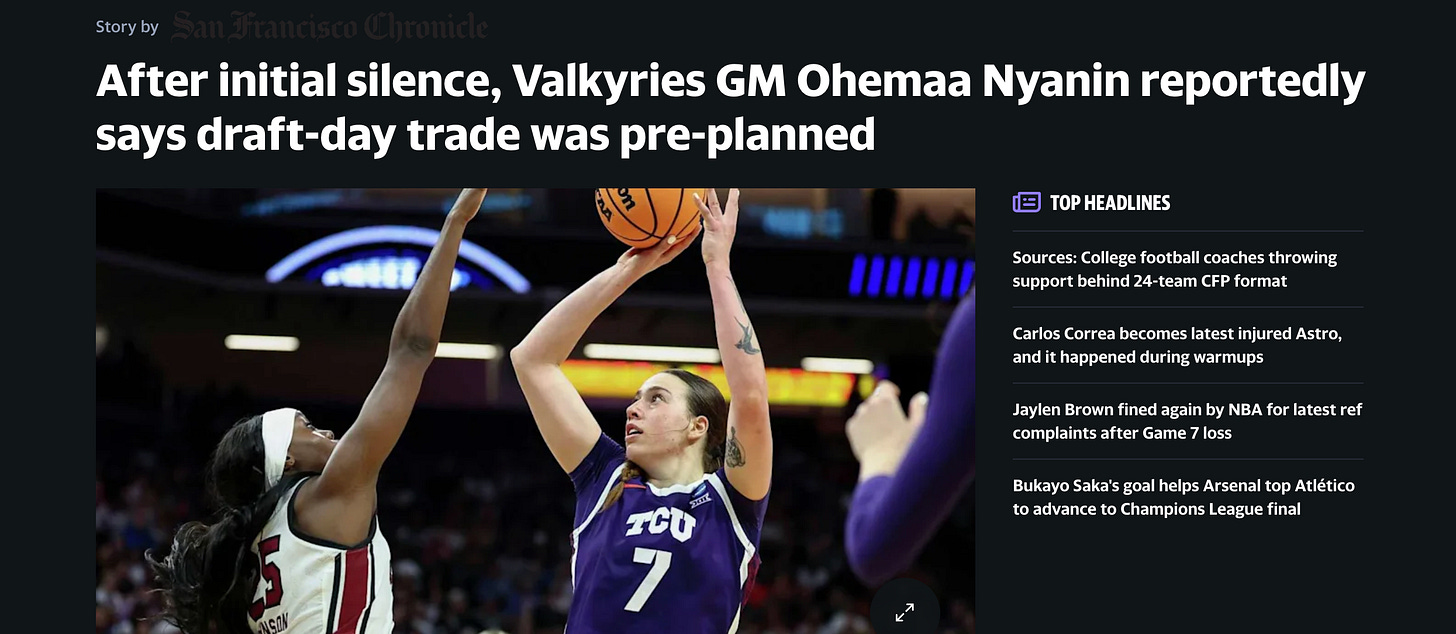
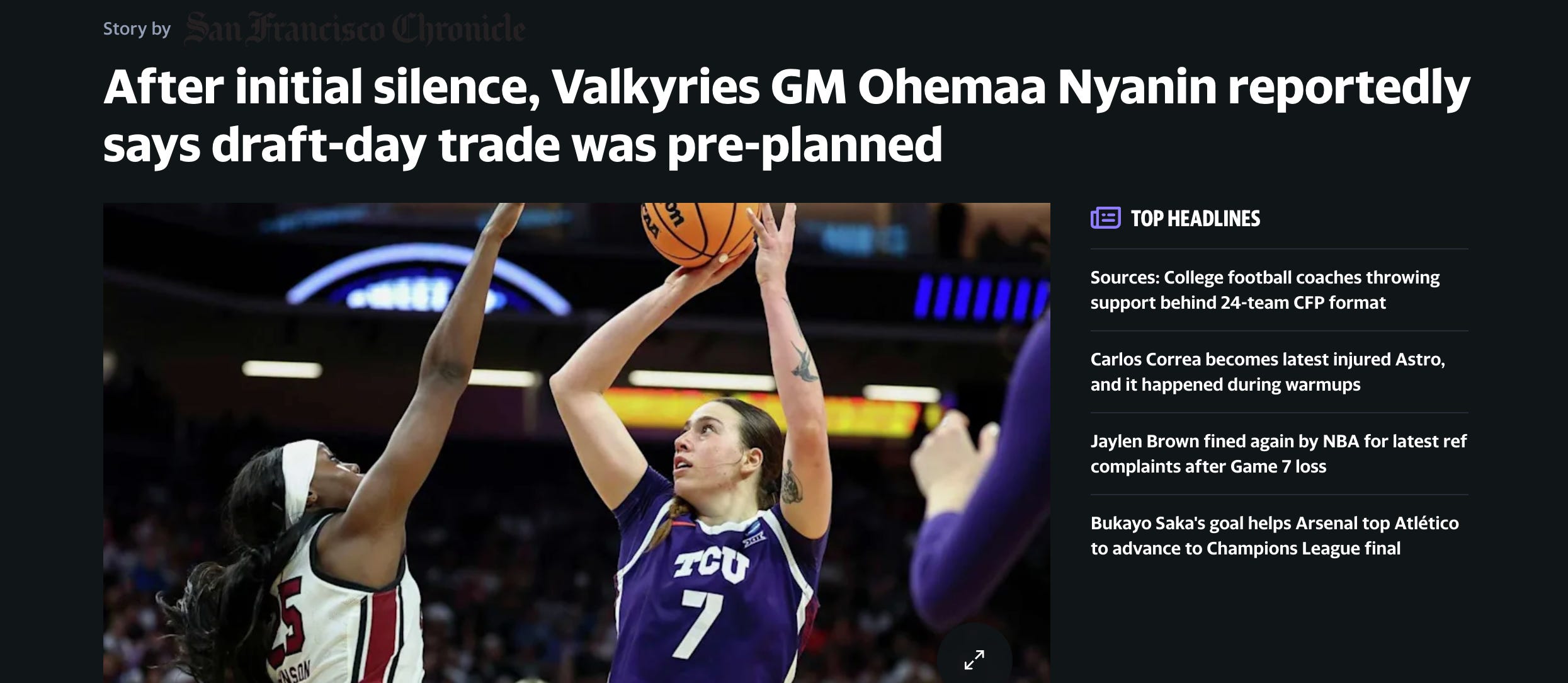
sure, chronicle, you could say that (article from april 13)

per ESPN,on april 14 the valks most wanted to publicly clarify that their trade had NOTHING to do with flau’jae (and yet, as we now know, also… everything?) It’s really just a dance, an interaction that requires some kind of bridge-building, wherein General Managers have to respond to questions from the outside, across that divide. I’ve noticed that Natalie Nakase is really good at recognizing that, and she’ll even put herself in the shoes of the press corps, significantly easing the strain. Like at media day, when emphasized the need to construct a roster with chemistry, or else: “You guys know, if you’re ever in a bad relationship, or you’re ever in a wrong relationship, that’s tough!” It’s a point of comparison, a way of reaching out — even if she wasn’t directly answering the question (in this case, about her approach to filling the final two roster spots), as Eric pointed out to me. It still gives the press something satisfying to use, and a way of making people feel seen.
Ohemaa doesn’t really do that, at least not in her rhetoric. She’s clearly an obsessive thinker, an incredibly hard worker, the colleague most likely to be up at all hours of the night still strategizing. What’s interesting is that she also forefronts this language of humanity - or a “human-first attitude,” as she said at media day, in all of her decision-making. This language implies that Ohemaa intends to do something that journalists aren’t actually getting from her explanations, not directly: a sense of connection, of care through mutual understanding.
And I wonder how, over time, this language will land with Valkyries fans — if/when the franchise makes another decision that, from the outside at least, portrays a kind of harsh brutality. Will the touch-y feely language used by the front office land with comfortable familiarity for Bay Area fans, or will the discordance between tone and action (at least, action as its perceived) end up creating more conflict, tension, and strain?

Keep reading with a 7-day free trial
Subscribe to rough notes to keep reading this post and get 7 days of free access to the full post archives.