


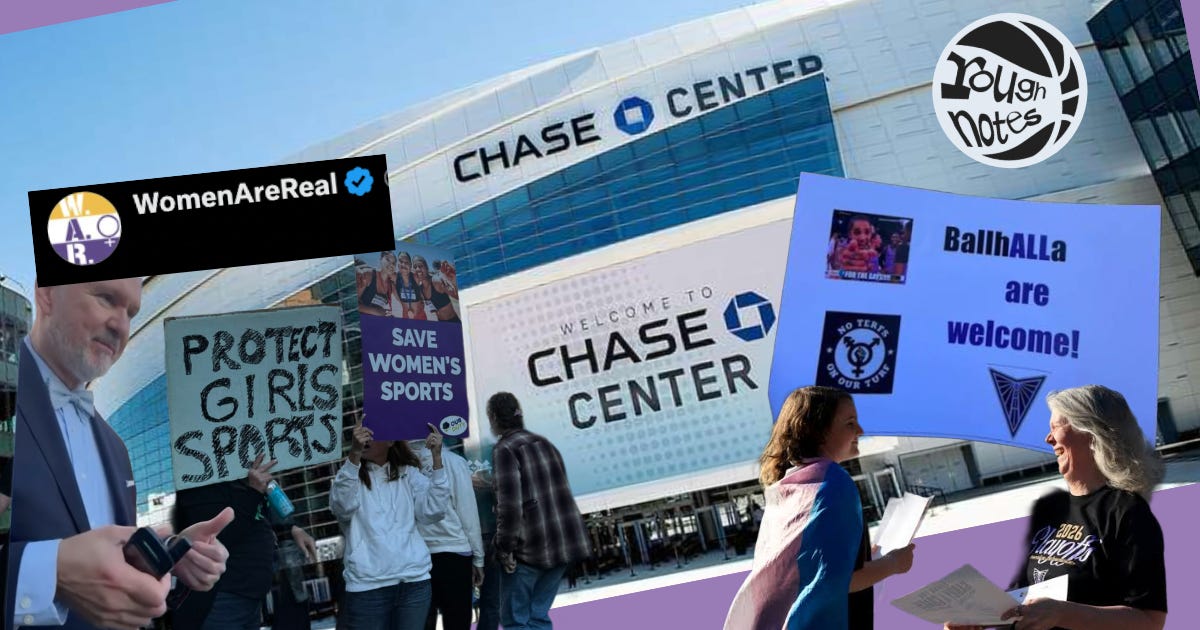
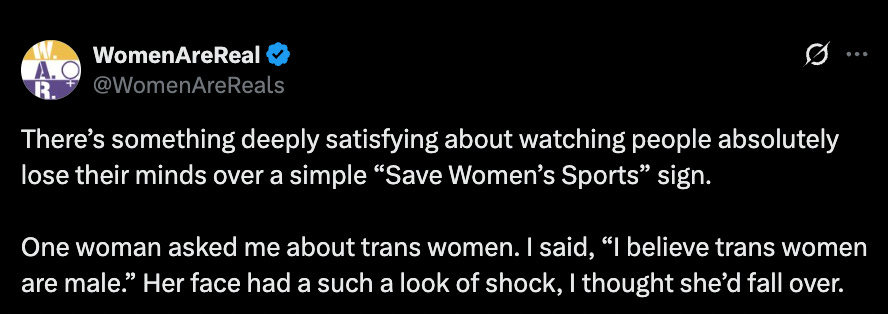
Earlier this week, I published an essay here on Rough Notes about what happened when a Bay Area-based anti-trans group called “Women Are Real” - or WAR, the same acronym the White Aryan Resistance - demonstrated directly outside Chase Center on August 19. After being told by one security guard that no protests were allowed on the property, I had a strange encounter with her colleague, a man who I’d been told was asking the group to leave, but then refused to give me any information about protocol when the group remained, over half an hour later, waving their signs. I was surprised by how rude and defensive he was to me. Here’s the full piece:

Soon after publishing, I heard from a woman named Emily. She was also distressed by what she’d seen the night of August 19, when she witnessed the “WAR” group at the game, and spoke to Valkyries staff about their presence.
Emily also sent me a video - one I hadn’t seen before - of the very same security guard I’d spoken to, this time published to Fox News. It was actually recorded by “Women are Real,” and Emily told me that when she first saw it (just after the protest) she found it “weird, like that security kind of enabled them.”
In the video, the security guard can be heard saying: “The chromosome shirts are not offensive” and giving one of the protestors, former Republican Trump appointee and SF politician Marie Hurabiell, a high five. Here it is:
Emily wanted to share her candid feelings with me about all this, but she was also nervous about upsetting Valkyries staff and her position as a season ticket holder. So, to protect her anonymity, we’re leaving out a few details and using the name Emily a pseudonym. Here’s our conversation.


Maya: So what do you remember about arriving at the Valkyries game on August 19th?
Emily: I got there early so I definitely saw [the “Women Are Real” group] kind of like setting up and interviewing by the East Side entrance, and in the moment it was really jarring. I think I just felt surprised that A) it was happening in San Francisco of all places, and B) that it was happening at a non-Fever game.
I saw the shirts they were wearing and I knew immediately what was going on. It was really disappointing to see that it was primarily lesbian [self-identifying] TERFs, members of this Bay Area community, the community I’m part of, who are being pretty hateful and exclusionary.
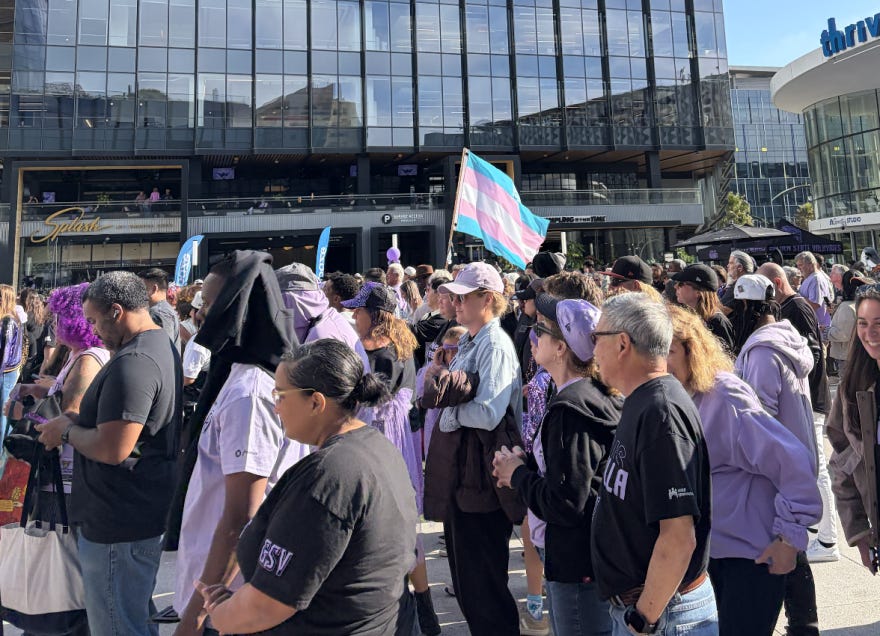
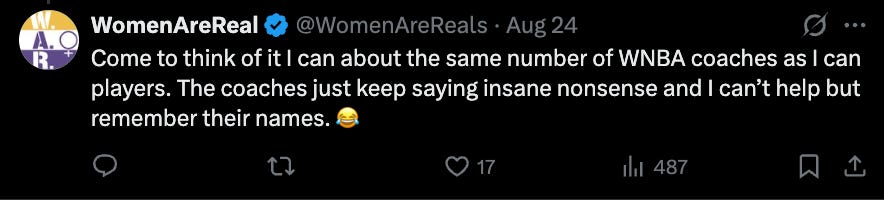
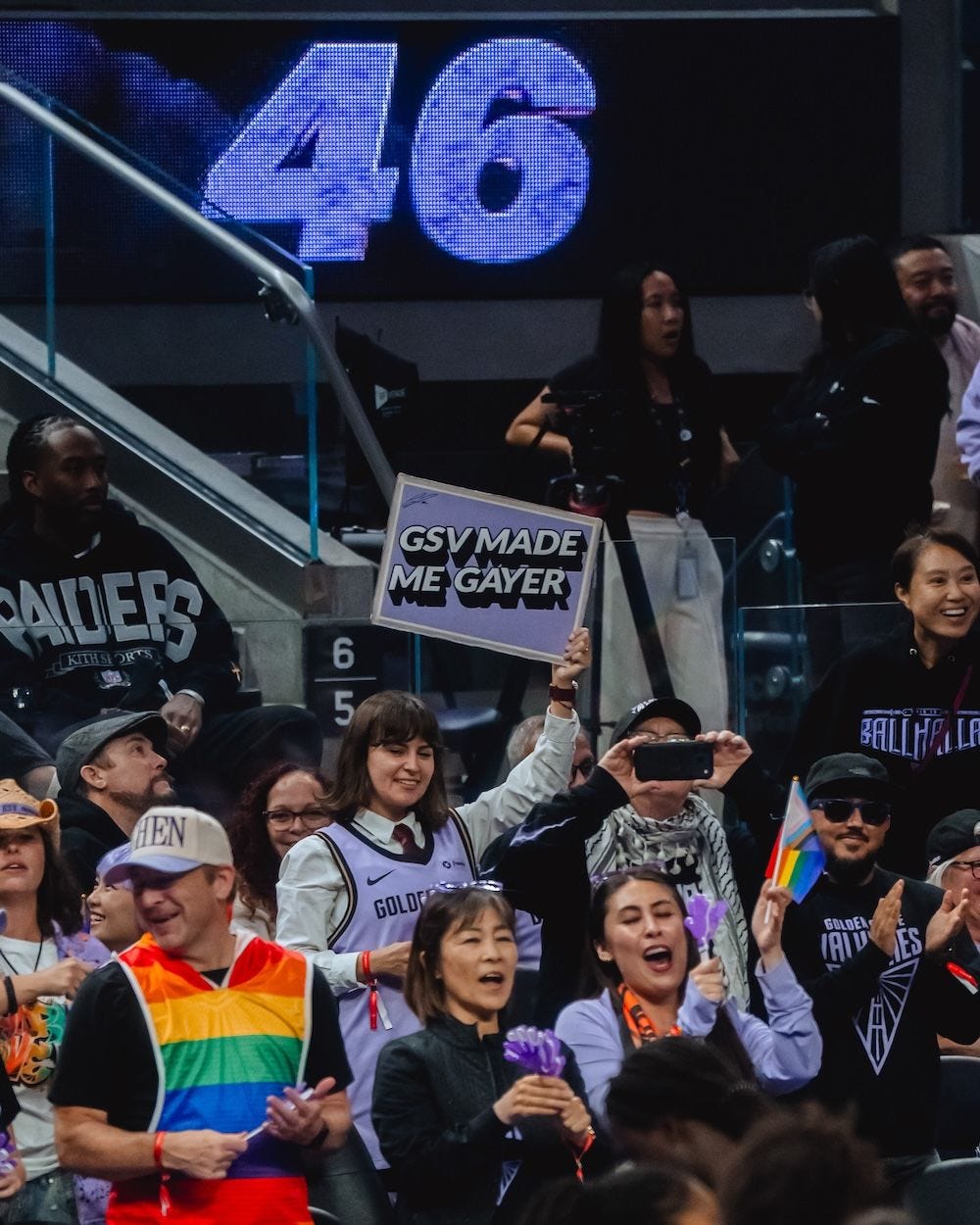
I mean, I’m sure you’ve been to Ballhalla. It’s a very queer space and a very trans space, honestly. And it was clear to me that this group does not belong to this community and is not engaged with this community because if they were… I think that a lot of people within the Valks fan base, even if they’re not queer or trans, they know it’s just so visible in our community - it’s very uplifted and kind of promoted.
Maya: That’s interesting to hear! How do you see queerness and transness being uplifted or promoted within Valkyries fandom?
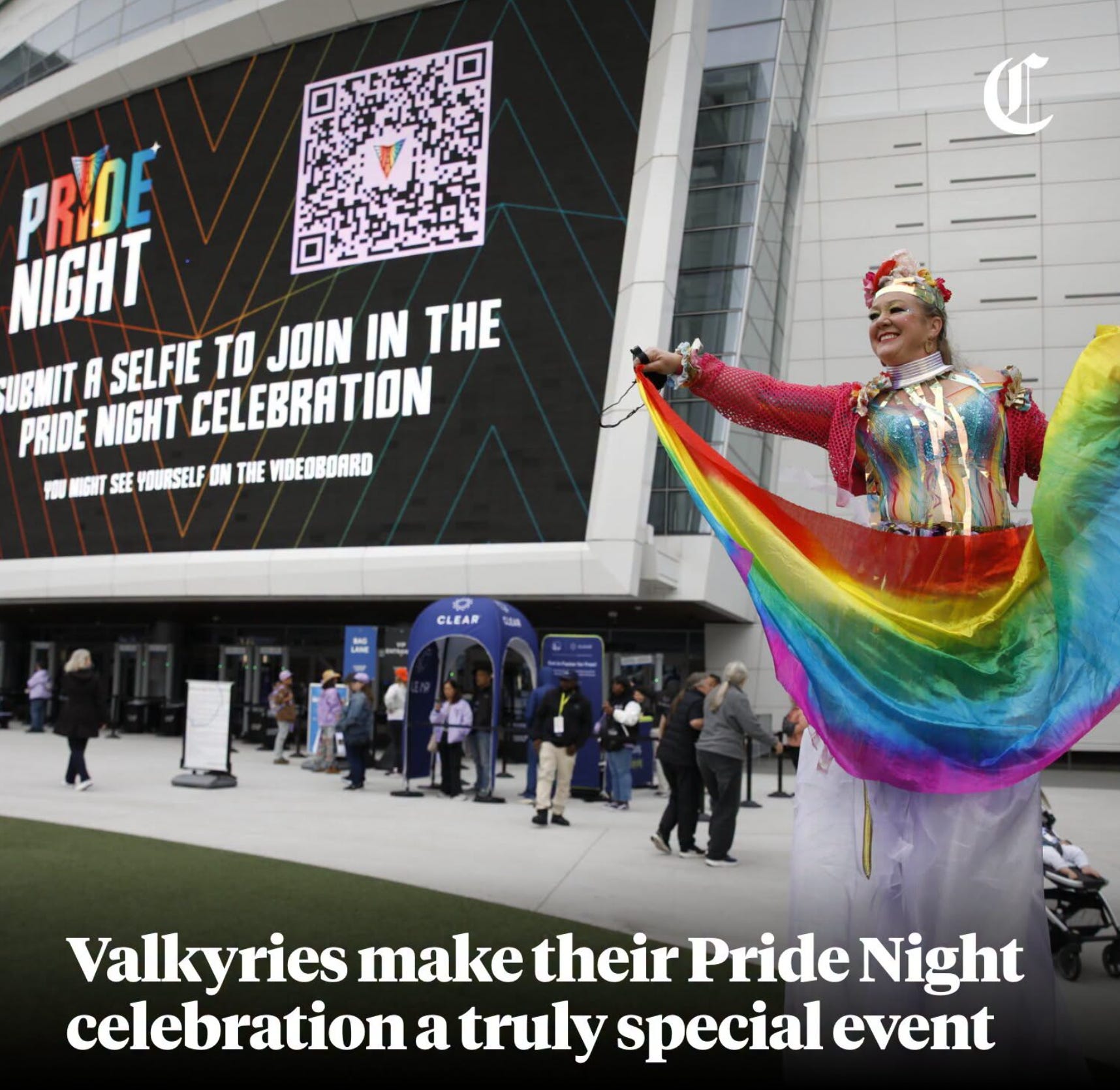
Emily: Well, I mean I, one way is how our players and our coach spoke on this in the media. The regular promotion of queer artists, businesses and spaces. Our Pride Night is, you know, through the roof. And I think especially like with everything that happened with the Giants and their Pride Night, the Valks have kind of become this stark contrast of how to specifically treat your LGBTQ fan base.
Because at the end of the day, and I don’t mean this negatively, but when you’re hosting a Pride Night, you [as a corporate entity] are appealing to the queer and trans community in order to get revenue out of them. So like if you’re going to invite people into the room who are part of a specific community because you wanna make money off of them, the bare minimum is showing them a modicum of respect. I know that’s blunt, sort of the bigger business way to view that.
Maya: Got it. What else came up for you when you saw the “Women Are Real” group?
Emily: I was really surprised, and I think I was also kind of surprised by the response to it at Chase Center. I mean, I’m not sure what the better response would have been. I don’t know if causing a scene is what this group would have wanted, or if it’s better to ignore it, to not engage.
Well, I was there quite early, so I don’t know if everyone clocked what was going on. I definitely saw the XX-XY shirts from afar and was immediately like, “oh I know what this is about to turn into.”
There’s no conflict, ever, in Ballhalla - that hasn’t really been an issue. There seems to be a standard and consistent vibe and community that’s coming to these games. Even if there’s a lot of the fanbase from another team in Ballhalla, there’s some degree of respect and no kind of concerns of conflict. But this was like, “Hey, this could be contentious or upset people really fast and upset people who are here every single game.”
Maya: How did the staff respond to that concern?
Emily: It didn’t seem like they were prepared. Like they hadn’t asked themselves, “Hey, this is happening at other games, so if this happens at Ballhalla, how do we address it? How do we respond to fans that are upset? How do we respond to fans that are protesting? What are our rules of engagement?” And I’m surprised by that.
In that moment, everyone was just kind of like: “Oh well, you know, don’t let it affect you,” or like, “I hope you still have fun.” You know, that kind of response, like: don’t let it bother you. And I was like: “I mean it is bothering me, that’s why I’m bringing it up to you.” I have reason to be concerned - this is something that has gotten contentious, and we’ve seen how it’s played out: there’s been harassment of players while they’re playing related to this issue. There’s been owners yelling at children and getting in trouble. We’ve seen it in Atlanta where people were asked to cover their shirts and then the organization apologized for asking them to cover their shirts. No one knows how to handle this. They’re making off the cuff decisions, then they’re regretting those decisions and distancing it from it. There hasn’t been a really strong position of, “this is how we’re gonna handle this and how we’re gonna protect players and fans.”
I would think that there are conversations happening behind the scenes - like, “we don’t know if and when this is gonna come to Ballhalla, but it probably will.” Like I’m sure they’ve had internal conversations of: “how do we manage it if someone throws a dildo on the court?” Because that kept happening during games.
But it seems like there wasn’t a plan in place to protect the fans. There’s definitely not a plan in place to protect the players. I know Gabby got a lot of harassment after her statements. She seemed pretty upset and shaken up, and she’s talked about the harassment online, so it just seems odd to me that the Valkyries as an organization haven’t done anything.
Ultimately what happened is the fan base responded. As I expected that they would. I think they pretty much drowned out this group. I don’t think it was as impactful as the protestors wanted it to be. I think they picked the wrong team and location to do this at.
Maya: Did the security guards or cops say anything about whether the group was allowed to protest there?
Emily: I asked them about it and their response was like, “we’re aware and we’re paying attention to it.” They would not give any clear answers on what was allowed, and what was not allowed. There was no clear determination. Just a very professional answer, kind of like: I’m not gonna give you an opinion on what’s allowed and what’s not allowed. But I know at the end of the day that it’s private property where fan conduct must be followed. Like if there are rules about whether I’m allowed to vape in Thrive City, there are rules about what other people are allowed to do in Thrive City.
Maya: And tell me more about what felt so upsetting to you personally about this happening at a Valkyries game?
Emily: I think the fact of seeing people being emboldened to use their opinions to completely hijack all of the really important things that are happening in the sport. Like I always joke with my friends, I’m like, “Ballhalla is my favorite place on earth.” Because it really is, oh god, I’m even getting emotional [Emily starts crying]. Because being a queer athlete, and those spaces not existing when I was growing up - and the fact that this exists here now? My girlfriend and I joined in the inaugural season, and it’s just been this really special, sacred place that feels like it was built for us. So it’s heartbreaking to see people coming in trying to ruin it.

And as a member of the fan base, feeling like there wasn’t necessarily a prioritization to protect what this space means to a lot of people - it’s just sad and scary to think that maybe once we’re in year 3 or 4, we’re gonna be looking back at it, like: “man how great were the 1st and 2nd years?” And I don’t want to do that! I hope that one day I’ll be I’m taking my kids to these games and I want it to continue being this environment where it’s cool and safe and normal for a family to look like ours, for your friends to look like ours, for your community to look like ours.
For my partner and I, it’s become such a huge part of our lives and our relationship - and there are very few spaces that feel like they are specifically built for queer women and trans people. Being season ticket holders in this space feels like it was built for us, and then to see this, it was kind of like, hey, maybe it wasn’t built for us. Maybe we just were the ones that were willing to show up and pay the money, maybe there’s no behind-the-scenes game plan to protect us? Like maybe I was duped.
I don’t actually feel that way, and I still strongly love the Valkyries organization. And I do believe that they are very cognizant of who their fan base is - but I think that that was the first time that I kind of had the ick of like, oh, maybe they don’t. Maybe they’re not prepared for this, or they don’t care, maybe they’re okay with eventually the queer community getting priced out, or the fan base changing as long as the valuation keeps going up.
Maya: Do you feel comfortable talking to other people about these feelings of doubt, when they come up?
Emily: I don’t know if I’ve talked much about that. Certainly, I talked to friends about that evening and how upsetting that was. But even at that game, given how upset I was, I was kind of quiet and negative going inside, but the second the game started, I was right back in it. But also, I do want to remain anonymous because I’m critiquing how this was handled internally and externally - and as a season ticket holder, I want to continue showing up to Ballhalla where conflict is hopefully still an anomaly.
I just think there’s something really magical happening with the Valks. In the past, the staff and internal culture have really given off the air that it’s important to protect their fans and to protect this space and for it to continue to feel sacred for everyone - so I hope now they’re listening and learning and implementing changes.
After note: according to Chase Center policy, prohibited activities include: “Signs, posters, placards, displays or written materials [that] contain or depict “fighting words,” obscenities, pornography, grisly or gruesome displays, highly inflammatory slogans likely to provoke a disturbance, or racial, religious or ethnic slurs.”
